A coffee bean tracker should do more than count bags. It should help you recognize a coffee, remember what its source promised, compare that with what you actually experienced, and decide whether it belongs on your shelf again.
Beanmemo keeps current and finished coffees in the same private library. Each saved coffee can hold its identity and Reference Profile, while your Journal keeps individual cups, ratings, observations, and next-time ideas.
Start with the coffee name. Add useful product details when you know them, choose On hand, Want to try, or Finished as its lifecycle changes, and keep Favorite and Buy again as separate decisions. A finished coffee can remain valuable history.
01
Track enough to recognize the coffee later
In Beanmemo, only the coffee name is required. Select the format—Whole bean, Ground coffee, Capsule / pod, or Other coffee—then add the roaster, origin, variety, process, roast, package information, price, and printed flavor notes when they are known.
Do not guess at missing information. The goal is not to complete every field; it is to preserve the details that will help you identify, compare, brew, or choose the coffee later.
- Coffee identity
- Name · roaster or brand · format
- Useful source details
- Origin · variety · process · roast · package
- Reference Profile
- The source description saved with the coffee
- Your cup evidence
- Journal ratings, observations, and next-time ideas
Keep two kinds of truth separate. A roaster’s tasting notes describe the coffee according to its source. Your Journal records what you perceived in a particular cup. They can be different without either record being wrong.
02
See your shelf without losing your history
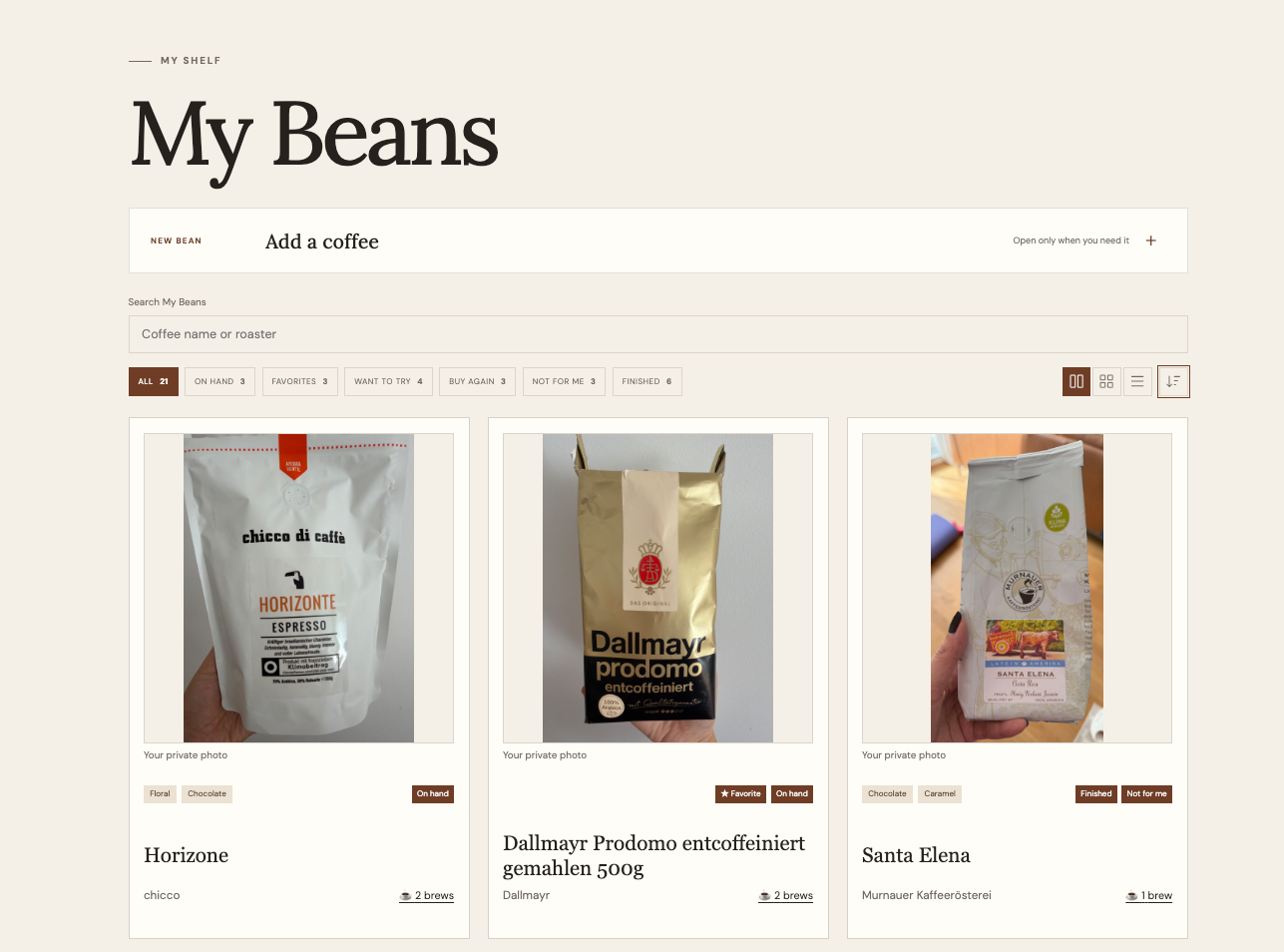
Beanmemo opens My Beans in All, so the complete library remains visible. Use On hand for coffee currently at home, Want to try before shopping, and Finished after the last cup.
- On hand / Want to try / Finished
- One lifecycle state at a time
- Favorite
- An independent personal highlight
- Buy again / Not for me
- A separate repurchase decision
A finished coffee can still be a Favorite. A coffee you enjoyed can still be marked Not for me because of taste, value, or availability. That is why shelf status, enjoyment, and repurchase intent should not be collapsed into one label.
03
Use a source to reduce manual entry
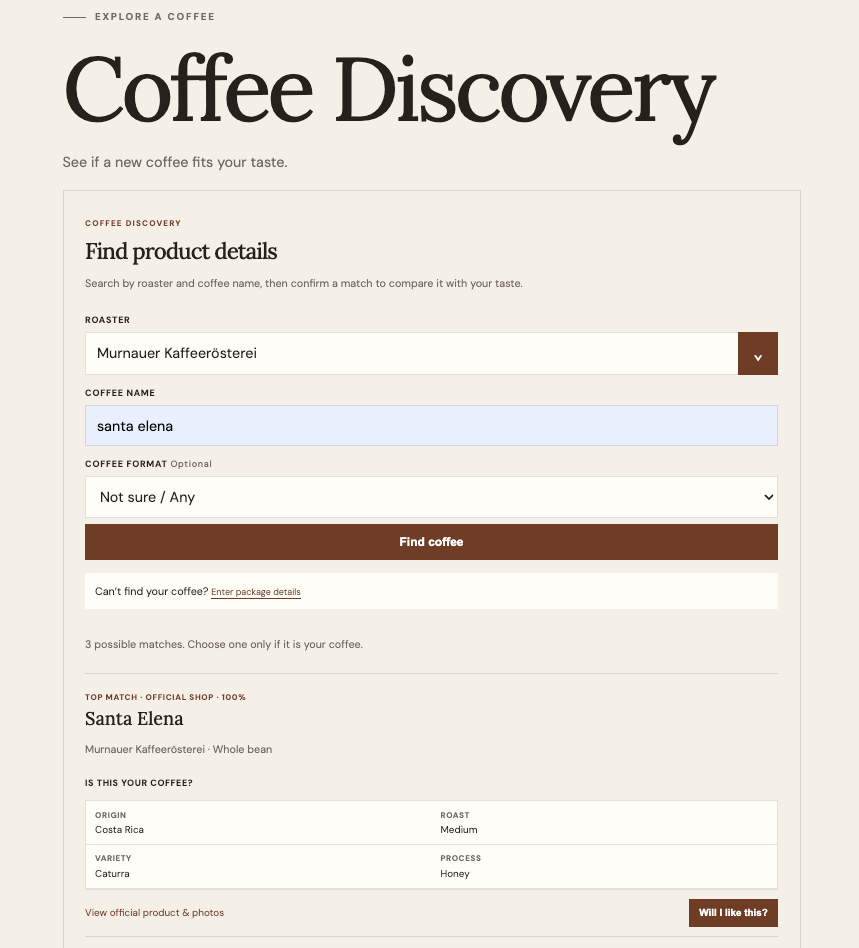
When a coffee is available from an identifiable official or trusted source, Coffee Discovery can help you review a candidate and save useful product details without typing everything from scratch. You remain responsible for selecting the right product and reviewing what is saved.
Source information stays visible so that a Reference Profile does not look like a personal tasting claim. Discovery is a starting point for the coffee record, not a prediction of what you will taste or how much you will like it.
04
A coffee I enjoyed, but probably wouldn’t buy again
A friend recently gave me a bag of Santa Elena, a Costa Rican whole-bean coffee from Murnauer Kaffeerösterei.
The roaster lists chocolate, caramel, and honey among Santa Elena’s tasting notes, while the packaging also mentions jasmine and brittle. Based on these descriptions, I expected something relatively sweet, nutty, and slightly floral.
I entered the roaster and coffee name into Beanmemo’s Coffee Discovery and reviewed a suggested match against the roaster’s official product page ↗. Coffee Discovery helped fill in some available product details, while I could still review, add, or correct information manually as needed.
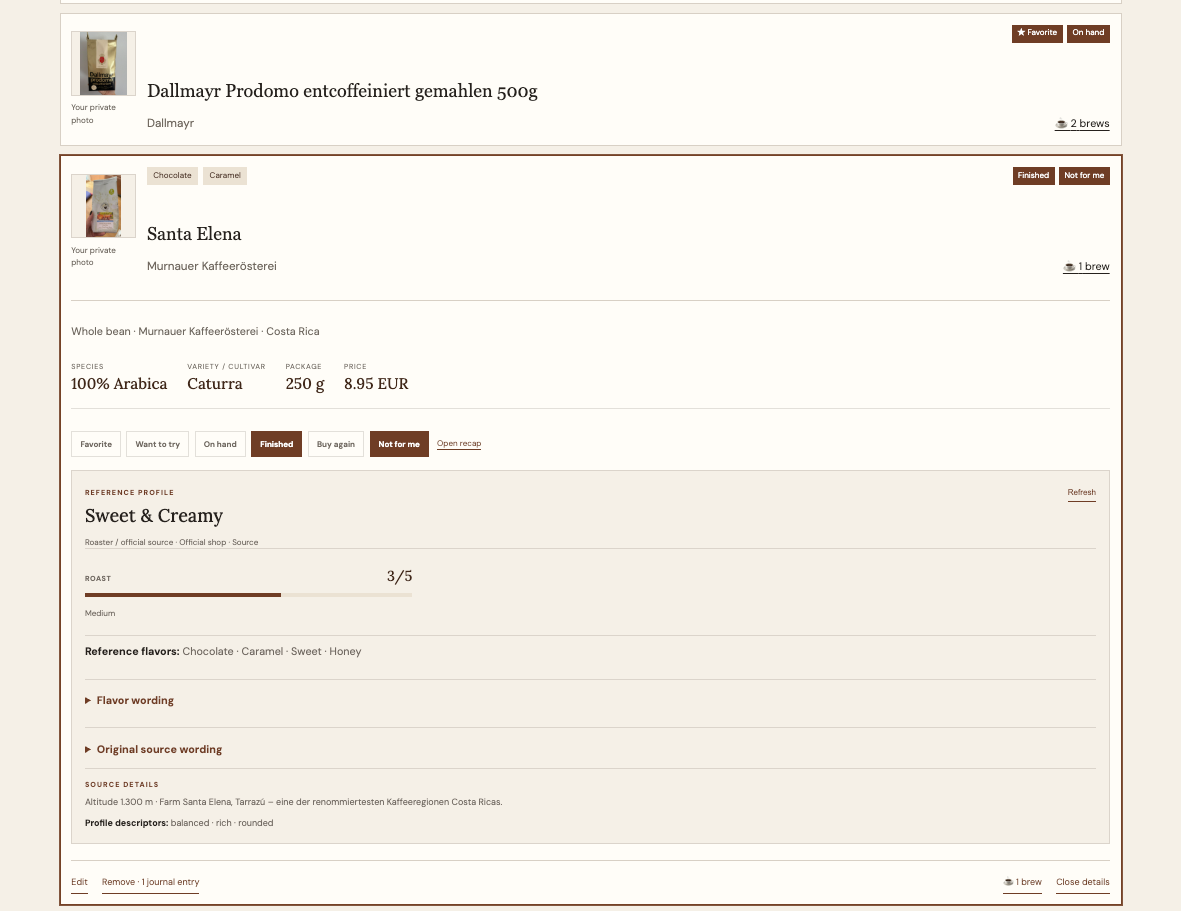
In Beanmemo, the saved coffee had a Reference Profile labeled Sweet & Creamy, with chocolate, caramel, sweet, and honey as reference flavors. These were reference details associated with the coffee, not a record of what I personally tasted. My own tasting observations came later, after brewing it.
What I actually experienced
When I brewed Santa Elena as a cappuccino with my espresso machine and oat milk, I rated it 7/10. It was not a bad cup, but the taste was quite different from what I had imagined.
My actual tasting record showed:
- Acidity
- 2/5
- Natural sweetness
- 2/5
- Bitterness
- 5/5
- Aroma
- 4/5
- Body
- 4/5
- Balance
- 3/5
I picked up some nutty, spicy, and honey-like notes, but the bitterness was much stronger than I expected. In my espresso-based cappuccino, it tasted too intense for my personal preference.
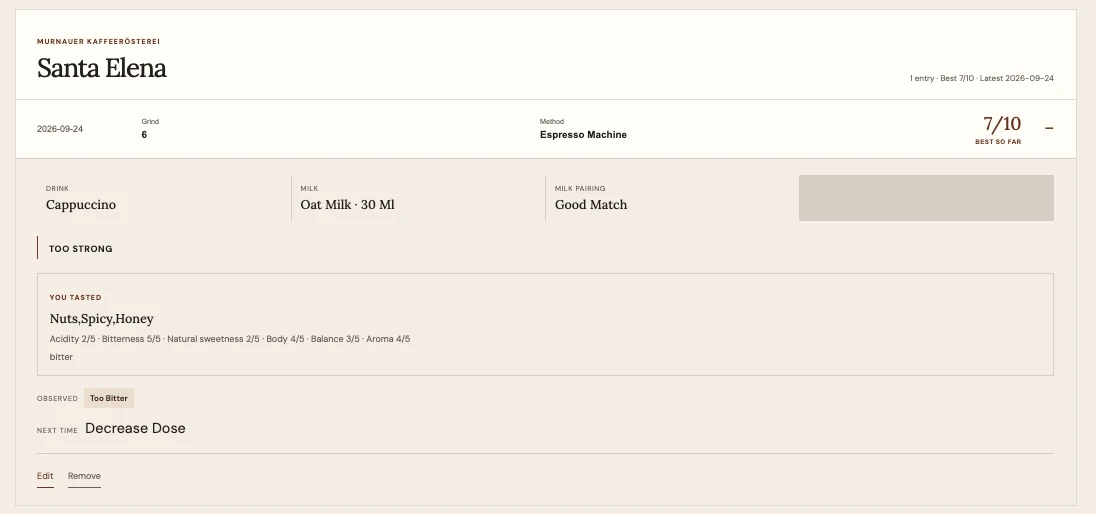
One cup, one honest record. “Decrease Dose” was the idea I saved for next time, not an adjustment I had already tested or proved. The score and observations describe this cup on my equipment, not an objective verdict on the coffee.

05
Enjoyment and repurchase are different decisions
Would I buy Santa Elena again? Probably not.
I finished the bag and reviewed the history Beanmemo had recorded: one logged and rated cup, averaging 7/10. I chose Not for me because the taste did not suit my preference as well as I had hoped.
Because there is only one rated cup, this recap cannot show a Best repeated context. Beanmemo only makes that comparison after at least two rated entries share the same method, drink, and machine/grinder context.
The recap covers journal history linked to this saved coffee identity. It does not currently separate one purchased bag or box from another purchase of the same saved coffee.
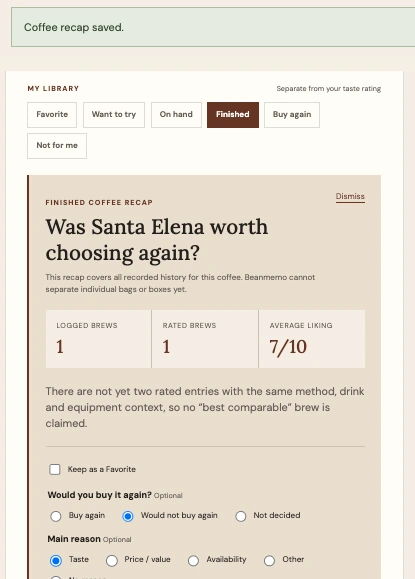
That does not make Santa Elena a bad coffee, and a different brewing approach might produce a different experience. It is simply what I learned from this cup. A 7/10 coffee can still be one I do not plan to repurchase. Remembering why is just as useful as remembering a favorite.
Because a coffee memory should help you make your next decision—not just remind you what you have already tried.
The name Beanmemo comes from coffee beans and memory. I built it to remember a coffee’s identity and reference profile, what I actually tasted, how much I enjoyed it, and whether I would choose it again.
06
A reusable coffee library checklist
- Save the identity. Begin with the name and format; add source facts you can verify.
- Set the lifecycle. Use On hand, Want to try, or Finished without deleting useful history.
- Record the cup separately. Keep your enjoyment, sensory ratings, observations, and next step in the Journal.
- Review before buying. Compare the source profile with your own experience, then decide Buy again or Not for me—and why.
Coffee Discovery and “Will I like this?” can support the choice, but they should not replace your own evidence. A source helps identify a coffee; your history helps you understand whether it suits you.
For cup-by-cup settings and tasting structure, use the coffee journal guide. For evaluating a new product before purchase, read how to decide whether you may like a coffee.
07
Coffee bean tracker FAQ
What should I track about a coffee?
Start with its name and format. Add roaster, origin, variety, process, roast, package information, source notes, and price only when they help you recognize or compare it.
Is Finished the same as deleting a coffee?
No. Finished removes the coffee from the active shelf view while preserving its saved identity and linked history. Delete only when you intend to remove the product after reviewing the confirmation.
Can I like a coffee and still choose not to buy it again?
Yes. Enjoyment describes your experience of the cup. Repurchase intent is a separate decision that can also reflect taste, value, availability, or another personal reason.
Does Beanmemo automatically track how much coffee is left?
No. Beanmemo is not an automatic stock counter. You update On hand or Finished when your real shelf changes.
Start your coffee library
Remember the coffee—and the decision it helped you make.
Keep coffee identity, reference details, real cup experiences, and repurchase decisions connected in one private place. Beanmemo is free during public preview, with no credit card required.
Start your coffee libraryKEEP READING