You do not need a complicated spreadsheet or professional tasting vocabulary to start a coffee journal. Begin with what you drank, how much you enjoyed it, and one thing worth remembering. Add brewing settings only when they help you repeat or adjust a cup.
A useful entry can describe whole beans, pre-ground coffee, or a capsule. The format changes which details matter; the purpose stays the same: make today’s experience useful the next time you choose or prepare coffee.
Record the date, the exact coffee, your method or cup, an enjoyment score, one observation, and one possible next step. Add method-specific settings only when they apply.
01
What is a coffee journal?
A coffee journal is a personal record of the coffees you drink and the experiences you have with them. It can help you remember products you enjoyed, repeat a good preparation, avoid an unsuitable purchase, and notice the flavors and formats you return to.
A tasting note describes what a cup tasted and felt like. A brew log records preparation and results. A practical coffee journal connects both. Beanmemo currently provides dedicated journal guidance for Espresso Machine and Capsule / Pad Machine. Its method selector also previews Automatic Machine, Moka Pot, V60, AeroPress, French Press, and Other while support for those preparation formats continues to expand.
02
Record only what makes the entry useful
Start by identifying the coffee as precisely as you can: its name or product, brand or roaster, and format—whole bean, ground coffee, capsule, or another format. Add origin, roast, process, or package notes when they are known, but do not postpone the entry to research missing label information.
Keep a small required core
Every entry needs a date, the selected coffee, and a 0–10 enjoyment score. Then add the context that explains the score: the method or drink, one honest observation, and what you might keep or change.
What Beanmemo supports today
Beanmemo’s most complete journal guidance currently covers Espresso Machine and Capsule / Pad Machine. Espresso entries can include a grind setting and, when useful, dose, actual yield, actual time, temperature, milk, and sensory details. Capsule entries do not require a grind setting and can record the cup program or drink instead.
The method selector also shows Automatic Machine, Moka Pot, V60, AeroPress, French Press, and Other as future-facing choices. More guidance for these preparation formats is planned; meanwhile, the copyable template below remains useful for any coffee.
03
A simple coffee journal template you can copy
Use this as a no-sign-up starting point for your next cup. Copy it into Notes, a document, or a paper journal so you do not have to decide what to record from scratch. The core fields make the entry useful later; the optional sections help when you want to compare the coffee, preparation, or taste in more detail.
Beanmemo follows the same idea, then keeps entries organized by coffee so you can search and compare them over time. Leave any optional line blank when it does not apply or the information is not stated.
Date:
Coffee name / brand:
Coffee format:
Method / cup:
Enjoyment (0–10):
One-sentence observation:
Next time:

Optional coffee details
Origin:
Bean type / species:
Roast:
Intensity:

Optional preparation details
Grind setting:
Dose (g):
Actual yield (ml):
Actual time (sec):
Water temperature (°C):
Milk type / amount (ml):

Optional taste ratings (1–5)
Acidity:
Natural sweetness:
Bitterness:
Aroma:
Body:
Balance:
Perceived flavors:
Keep the units attached. Dose is recorded in grams, while Beanmemo’s observed espresso yield is recorded in millilitres. A grind number is meaningful only with the same grinder.
04
Espresso and capsule journal examples
The values below are illustrative teaching data. They show how an entry can be structured; they are not universal recipes or claims that these cups were physically tested. Origin, bean type, roast, and intensity describe the coffee or its source label. The six taste ratings describe what the drinker perceived in that cup.
Screenshots show the real Beanmemo interface in separate, founder-provided form states; the worked recipes remain illustrative. Brand and product names shown in screenshots are for identification and illustration only. Beanmemo is not affiliated with or endorsed by these brands.
Coffee journal example: espresso machine
- Coffee
- Example Espresso Blend · whole bean
- Origin
- Brazil · Colombia
- Bean type
- Arabica–Robusta blend
- Roast
- Medium-dark
- Intensity
- High · source description
- Date
- October 8, 2026
- Method
- Espresso Machine · espresso
- Grind
- Setting 5
- Observed
- 9 g dose · 20 ml actual yield · 25 sec
- Enjoyment
- 8/10
- Taste ratings
- Acidity2/5Natural sweetness4/5Bitterness3/5Aroma4/5Body4/5Balance4/5
- Perceived flavors
- Cocoa · toasted nut
- Observation
- Balanced at first, with a slightly bitter finish
- Next time
- Keep the dose and yield; try one small step coarser
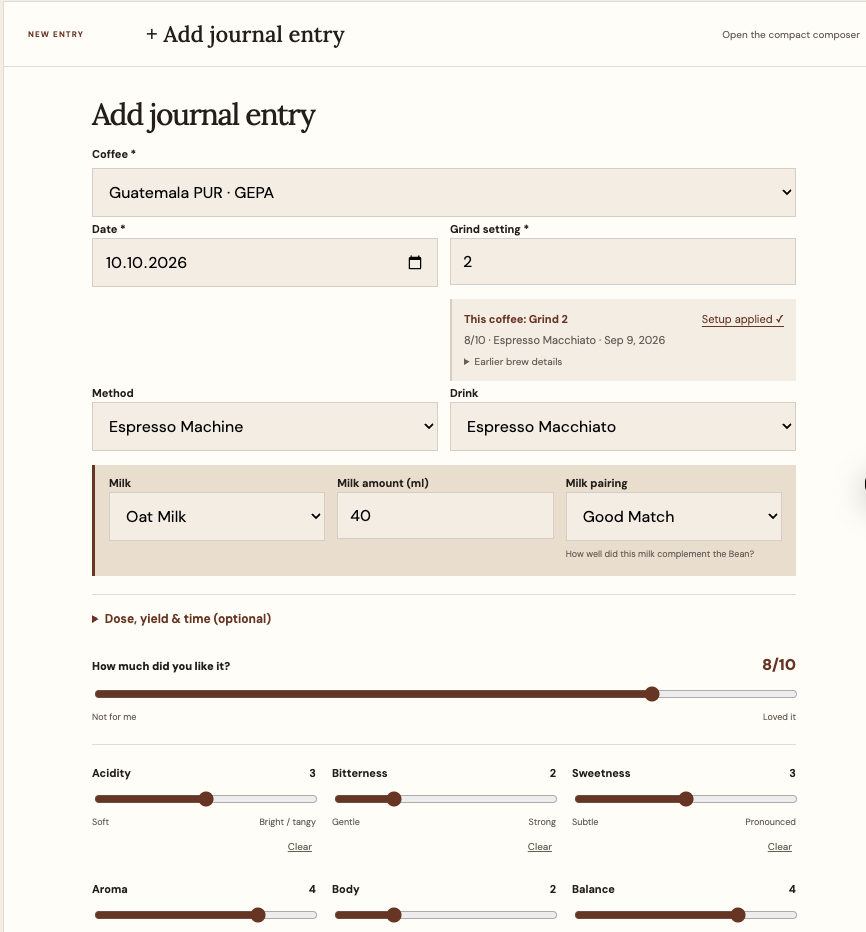
A future entry can keep the same dose and target yield, change only the grind, and compare the score and observation. That makes the note actionable without pretending one recipe suits every machine or coffee.
Coffee journal example: capsule machine
- Coffee
- Example Lungo Capsule · capsule
- Origin
- Colombia
- Bean type
- 100% Arabica
- Roast
- Medium
- Intensity
- 8/15 · capsule scale
- Date
- October 8, 2026
- Method
- Capsule / Pad Machine
- Cup
- Lungo
- Enjoyment
- 7/10
- Taste ratings
- Acidity2/5Natural sweetness3/5Bitterness2/5Aroma3/5Body2/5Balance3/5
- Perceived flavors
- Cocoa · caramel
- Observation
- Smooth while hot, but a little flat after cooling
- Next time
- Try as espresso and compare the intensity
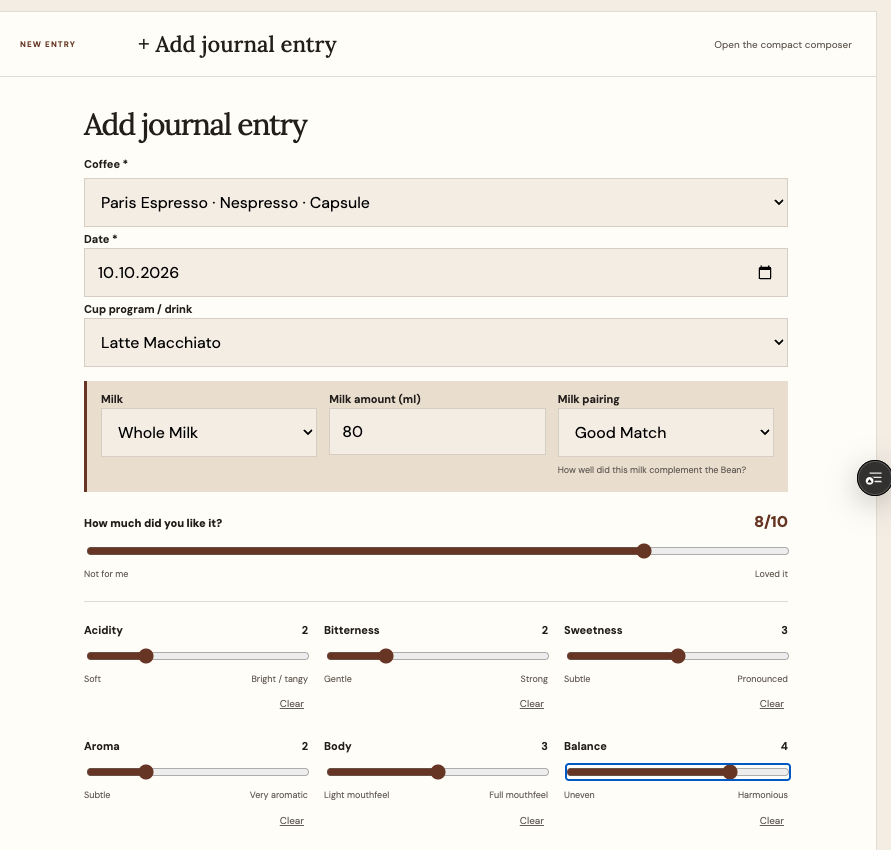
There is no grind, dose, water temperature, or extraction-time requirement here. Record origin, bean type, roast, or intensity only when the capsule source states them; do not invent missing product details. The exact capsule, cup program, enjoyment score, and personal taste ratings remain the useful core.
05
Why I built Beanmemo
I kept forgetting which grind setting had worked for a coffee once I moved on to trying other beans. I also wanted one place to remember the coffees I had bought, what they tasted like, and what I had learned from them. So I started keeping those details in a spreadsheet on my laptop.
The spreadsheet solved the memory problem, but opening my laptop whenever I wanted to add or check a coffee note soon became inconvenient. I built a simple phone-friendly interface for my own records, then realized other coffee drinkers might find it useful too. That became Beanmemo.
About the examples above: this founder story is first-hand. The espresso and capsule values are separate teaching examples, not a claim that Xin tested those exact recipes or scores.

06
Use ordinary words for taste
You do not need to identify rare flavor notes to keep a worthwhile journal. Ask whether the coffee felt bright or mellow, light or full, sweet or bitter, balanced or distracting—and whether you would choose it again.
“Smooth while hot, but flat after cooling” is useful evidence. So is “too bitter for me with this setting.”
Personal notes do not need to agree with the package. When more structure helps, rate only the dimensions you actually noticed, such as acidity, sweetness, bitterness, body, balance, or aroma.
Separate sensory character from enjoyment
A strong or bitter coffee is not automatically one you dislike. Sensory intensity describes the cup; the 0–10 enjoyment score describes your reaction. Keeping both lets different preferences remain valid.
07
Compare two entries, then choose one next step
Review entries for the same coffee together. If the illustrative espresso above scored 8/10 at grind 5 and a later cup scored 6/10 at grind 7, the journal does not prove that grind 5 is universally better. It does give you a concrete setting to revisit on the same equipment.
Change one controllable variable at a time when you can. Keep the adjustment if the next cup is better; return to the previous setting if it is worse. For capsules, compare cup programs, drinks, or milk pairings rather than inventing grinder variables that do not exist.
How Beanmemo turns notes into a useful history
Beanmemo keeps entries with their saved coffee, 0–10 score, notes, and relevant optional preparation details. Journal History can search by coffee, roaster, method, or note; group entries by coffee or date; and expand an entry to show the details and next adjustment you recorded.
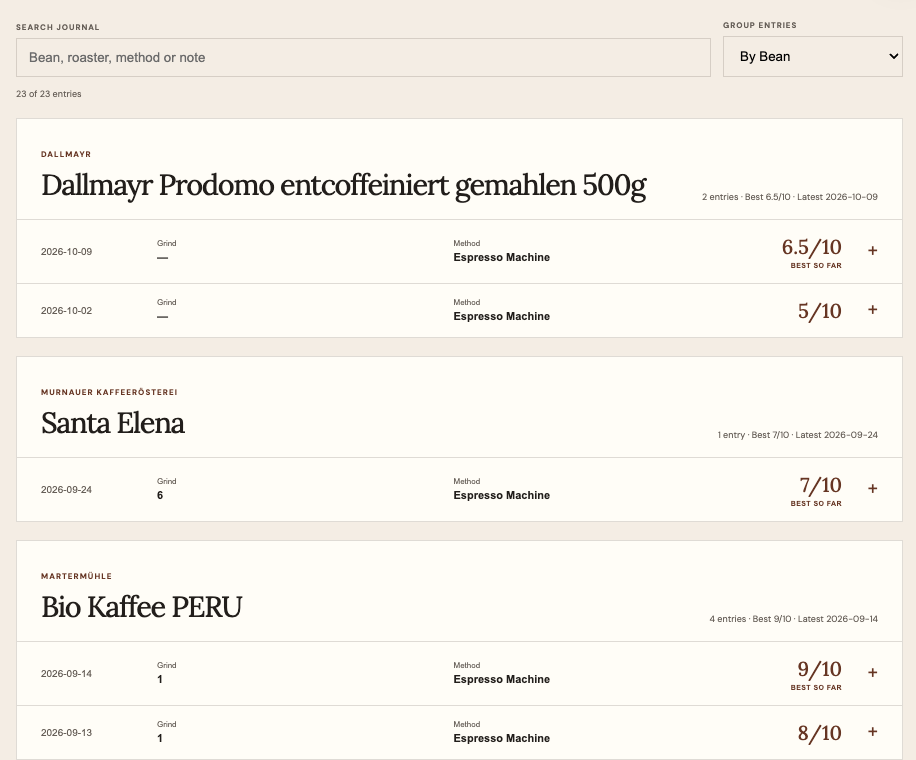
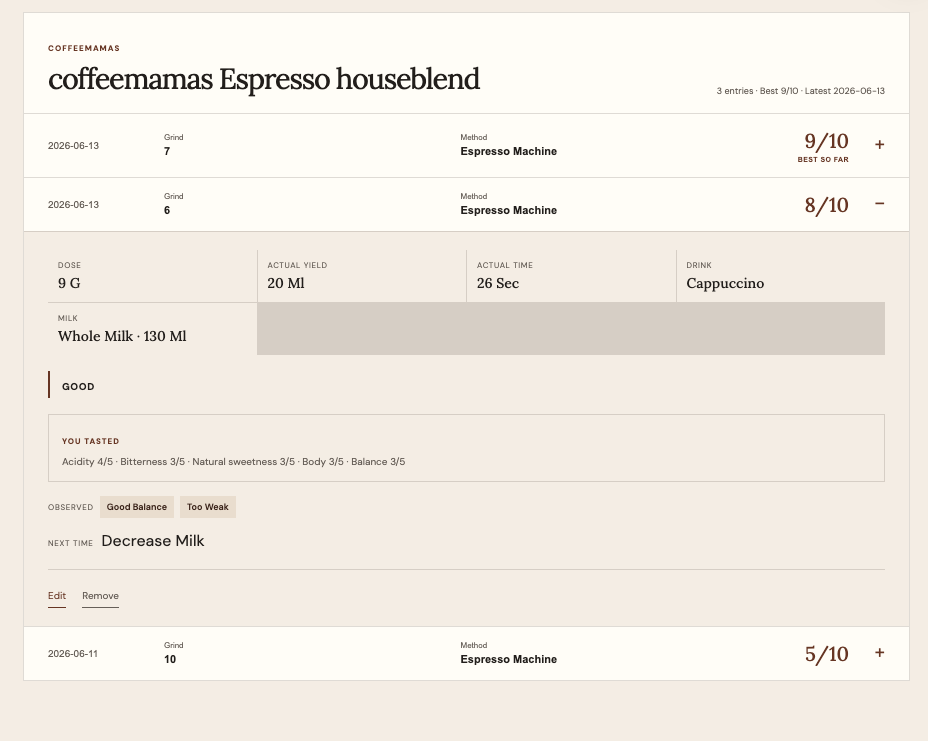
These entries are observational history, not a controlled grind experiment. Other preparation variables can differ between cups.
08
Paper, spreadsheet, or coffee journal app?
Paper is pleasant and distraction-free, but harder to search as the journal grows. A spreadsheet is flexible for detailed recipes, though it can feel like maintenance. A dedicated journal helps when the same coffee has several attempts and you want to find, group, and compare them later.
Whichever format you choose, make sure it can quickly answer two questions:
Have I tried this coffee before?
What should I repeat or change next time?
Begin with the coffee on your shelf
Save one coffee. Log one cup. Keep one useful next step.
Beanmemo is a private personal coffee journal for your coffees, brews, and evolving taste. It is free during public preview, with no credit card required.
Start your free coffee journal09
Trusted coffee references
You do not need professional terminology for a personal journal. When you want a more consistent vocabulary, these independent industry resources are useful starting points:
- World Coffee Research Sensory Lexicon ↗A research-based vocabulary of flavor, aroma, and texture attributes with sensory references.
- SCA Coffee Taster’s Flavor Wheel ↗A visual vocabulary for moving from broad impressions toward more specific descriptions.
- SCA Coffee Value Assessment ↗A professional framework that separates descriptive observations from affective evaluation.
These are professional reference systems, not rules a home coffee journal must copy. Use them when they help you find a word; keep your own enjoyment and next-cup decision at the center.
10
Coffee journal FAQ
What should I write in a coffee journal?
Record the date, exact coffee, method or cup, enjoyment score, one observation, and what you would keep or change. Add recipe variables only when they apply and help you compare or repeat a cup.
Do capsule coffees need grind and dose fields?
No. Identify the exact capsule, machine method, cup program or drink, and your reaction. Grind, dose, water temperature, and extraction time are not required for a capsule entry in Beanmemo.
Do I need professional coffee tasting vocabulary?
No. Familiar descriptions such as bright, mellow, bitter, light, creamy, or balanced are useful when they honestly describe your experience.
What is the difference between a coffee journal and a brew log?
A brew log focuses on preparation variables and results. A coffee journal can also connect the product, tasting experience, personal enjoyment, and later decisions across many entries.
KEEP READING